Learn to identify, assess, and mitigate DNS vulnerabilities before attackers exploit them
Published: August 2025 | Reading time: 12 minutes | Skill level: Intermediate
Summary
This comprehensive guide teaches cybersecurity professionals and enthusiasts how to conduct thorough DNS security assessments. We’ll cover reconnaissance techniques, vulnerability identification, privacy risk analysis, and hardening strategies. With governments implementing invasive age verification systems and DNS becoming a prime attack vector, understanding these risks is more critical than ever.
Introduction: Why DNS Security Matters More Than Ever
Domain Name System (DNS) is often called the “phonebook of the internet”—but it’s also its most overlooked attack surface. While you’re focused on firewalls and endpoint security, attackers are exploiting DNS vulnerabilities to steal data, inject malware, and bypass your security controls.
Recent developments have made DNS security even more critical:
- Government surveillance expansion through age verification laws requiring identity disclosure- DNS tunneling attacks using legitimate DNS traffic to exfiltrate data- DNS poisoning campaigns redirecting users to malicious sites- Privacy violations as ISPs monetize DNS query data
In this guide, you’ll learn to assess DNS security risks like a professional penetration tester, using both automated tools and manual techniques. We’ll also explore how emerging privacy solutions like NextDNS are changing the threat landscape.
*Want to dive deeper into DNS privacy implications? Check out our analysis: *NextDNS Age Verification Bypass: The DNS Revolution Against Digital ID Laws
Understanding DNS Attack Vectors
Common DNS Vulnerabilities
Before conducting assessments, you need to understand what you’re looking for:
DNS Cache Poisoning (DNS Spoofing)
- Corrupts resolver cache with malicious IP addresses- Redirects legitimate domains to attacker-controlled servers- Difficult to detect without proper monitoring
DNS Tunneling
- Uses DNS queries to exfiltrate data or establish command channels- Bypasses traditional network security controls- Often missed by standard security tools
DNS Amplification Attacks
- Exploits open DNS resolvers to amplify DDoS attacks- Uses small queries to generate large responses- Can overwhelm target networks with traffic
Subdomain Enumeration
- Discovers hidden services and attack surfaces- Reveals internal network information- Foundation for lateral movement attacks
DNS Rebinding
- Bypasses same-origin policy protections- Enables attacks against internal networks- Particularly dangerous in IoT environments
Government Surveillance Risks
With new age verification laws, DNS queries now pose additional privacy risks:
- Query logging by government-mandated verification systems- Identity correlation linking DNS queries to real identities- Behavioral profiling based on browsing patterns- Censorship implementation through DNS filtering
Understanding these risks is crucial for comprehensive security assessments.
DNS Reconnaissance Techniques
Passive Information Gathering
Start your assessment without directly interacting with target systems:
Historical DNS Data
# Query historical DNS records using SecurityTrails API
curl -H "APIKEY: your-api-key" \
"https://api.securitytrails.com/v1/history/example.com/dns/a"

# Alternative: Use DNSTrails for free lookups
dig @8.8.8.8 example.com ANY +short
Certificate Transparency Logs
# Find subdomains through certificate logs
curl -s "https://crt.sh/?q=%25.example.com&output=json" | \
jq -r '.[].name_value' | sort -u

# Use amass for comprehensive subdomain discovery
amass enum -d example.com -src
DNS Zone Transfers (AXFR)
# Attempt zone transfer (often restricted but worth testing)
dig @ns1.example.com example.com AXFR

# Test all discovered name servers
for server in $(dig +short NS example.com); do
    echo "Testing $server"
    dig @$server example.com AXFR
done
Active DNS Enumeration
Subdomain Bruteforcing
# Use gobuster for DNS subdomain discovery
gobuster dns -d example.com -w /usr/share/wordlists/subdomains.txt

# Fierce for recursive subdomain discovery
fierce -dns example.com

# DNSenum for comprehensive enumeration
dnsenum --enum example.com
DNS Server Fingerprinting
# Identify DNS server software
nmap -sU -p 53 --script dns-nsid target-dns-server

# Check for version information
dig @target-dns-server version.bind chaos txt
DNS Security Extensions (DNSSEC) Testing
# Check DNSSEC validation
dig +dnssec +multiline example.com

# Verify chain of trust
delv @8.8.8.8 example.com +rtrace
Vulnerability Assessment Methodology
Step 1: Infrastructure Discovery
Identify DNS Infrastructure
#!/usr/bin/env python3
import dns.resolver
import socket

def discover_dns_infrastructure(domain):
    results = {}

    # Get authoritative name servers
    try:
        ns_records = dns.resolver.resolve(domain, 'NS')
        results['name_servers'] = [str(ns) for ns in ns_records]

        # Get IP addresses for name servers
        ns_ips = []
        for ns in results['name_servers']:
            try:
                a_records = dns.resolver.resolve(ns.rstrip('.'), 'A')
                ns_ips.extend([str(ip) for ip in a_records])
            except:
                pass
        results['ns_ips'] = ns_ips

    except Exception as e:
        print(f"Error discovering NS records: {e}")

    return results

# Usage
domain = "example.com"
info = discover_dns_infrastructure(domain)
print(f"DNS Infrastructure for {domain}:")
for key, value in info.items():
    print(f"  {key}: {value}")
Step 2: Configuration Analysis
Check for Recursive DNS Vulnerabilities
#!/bin/bash
# Test for open recursive DNS servers
test_recursion() {
    local dns_server=$1
    echo "Testing recursion on $dns_server"

    # Query external domain
    result=$(dig @$dns_server google.com +short +time=5)

    if [ ! -z "$result" ]; then
        echo "  [VULNERABLE] $dns_server allows recursion"
        echo "  [RISK] Can be used for DNS amplification attacks"
    else
        echo "  [SECURE] $dns_server blocks recursion"
    fi
}

# Test discovered DNS servers
for server in 8.8.8.8 1.1.1.1; do
    test_recursion $server
done
DNS Security Assessment Script
#!/usr/bin/env python3
import dns.resolver
import dns.query
import dns.message
import socket
from datetime import datetime

class DNSSecurityAssessment:
    def __init__(self, target_domain):
        self.domain = target_domain
        self.vulnerabilities = []

    def check_dns_recursion(self, dns_server):
        """Test for open DNS recursion"""
        try:
            # Query external domain through target server
            resolver = dns.resolver.Resolver()
            resolver.nameservers = [dns_server]
            resolver.timeout = 5

            # Try to resolve external domain
            result = resolver.resolve('google.com', 'A')
            if result:
                self.vulnerabilities.append({
                    'type': 'Open DNS Recursion',
                    'severity': 'High',
                    'server': dns_server,
                    'description': 'Server allows recursive queries for external domains'
                })
                return True
        except:
            return False

    def check_dnssec_validation(self):
        """Check DNSSEC implementation"""
        try:
            resolver = dns.resolver.Resolver()
            resolver.use_edns(0, dns.flags.DO, 4096)

            # Query with DNSSEC validation
            result = resolver.resolve(self.domain, 'A')

            # Check if DNSSEC is properly implemented
            if not result.response.flags & dns.flags.AD:
                self.vulnerabilities.append({
                    'type': 'Missing DNSSEC',
                    'severity': 'Medium',
                    'description': 'Domain lacks DNSSEC validation'
                })

        except Exception as e:
            self.vulnerabilities.append({
                'type': 'DNSSEC Error',
                'severity': 'Low',
                'description': f'DNSSEC validation failed: {str(e)}'
            })

    def check_dns_over_https_support(self, dns_server):
        """Check for DNS-over-HTTPS support"""
        import requests

        doh_urls = [
            f'https://{dns_server}/dns-query',
            f'https://{dns_server}/resolve'
        ]

        for url in doh_urls:
            try:
                headers = {'Accept': 'application/dns-json'}
                params = {'name': self.domain, 'type': 'A'}

                response = requests.get(url, headers=headers, params=params, timeout=5)
                if response.status_code == 200:
                    return True
            except:
                continue
        return False

    def generate_report(self):
        """Generate assessment report"""
        print(f"\nDNS Security Assessment Report for {self.domain}")
        print("=" * 60)
        print(f"Scan completed: {datetime.now().strftime('%Y-%m-%d %H:%M:%S')}")
        print(f"Total vulnerabilities found: {len(self.vulnerabilities)}")

        if self.vulnerabilities:
            print("\nVulnerabilities:")
            for i, vuln in enumerate(self.vulnerabilities, 1):
                print(f"\n{i}. {vuln['type']} - {vuln['severity']}")
                print(f"   Description: {vuln['description']}")
                if 'server' in vuln:
                    print(f"   Affected server: {vuln['server']}")
        else:
            print("\n✓ No critical DNS vulnerabilities detected")

# Usage example
assessment = DNSSecurityAssessment("example.com")
assessment.check_dnssec_validation()
assessment.generate_report()
Step 3: Privacy Risk Assessment
Age Verification Compliance Analysis
With new government regulations, DNS queries can expose users to identity verification requirements:
#!/usr/bin/env python3
import requests
import dns.resolver
from urllib.parse import urlparse

class PrivacyRiskAssessment:
    def __init__(self):
        self.age_verification_domains = []
        self.privacy_risks = []

    def check_age_verification_requirements(self, domain):
        """Check if domain requires age verification"""
        # Common indicators of age verification requirements
        verification_indicators = [
            'age-verification',
            'verify-age',
            'adult-content',
            'id-check',
            'document-upload'
        ]

        try:
            # Check domain content for verification requirements
            response = requests.get(f'https://{domain}', timeout=10, allow_redirects=True)
            content = response.text.lower()

            for indicator in verification_indicators:
                if indicator in content:
                    self.privacy_risks.append({
                        'domain': domain,
                        'risk': 'Age Verification Required',
                        'indicator': indicator,
                        'severity': 'High',
                        'description': 'Site may require government ID upload'
                    })
                    return True

        except Exception as e:
            pass

        return False

    def assess_dns_privacy_risks(self, dns_server):
        """Assess DNS privacy risks from server"""
        risks = []

        # Check for DNS-over-HTTPS support
        if not self.check_doh_support(dns_server):
            risks.append({
                'type': 'Unencrypted DNS Queries',
                'severity': 'Medium',
                'description': 'DNS queries transmitted in plaintext'
            })

        # Check for logging policies (manual verification needed)
        risks.append({
            'type': 'DNS Query Logging',
            'severity': 'Medium',
            'description': 'Verify DNS provider logging policies manually'
        })

        return risks

    def check_doh_support(self, dns_server):
        """Check DNS-over-HTTPS support"""
        # Implementation would test DoH endpoints
        # This is simplified for demonstration
        known_doh_servers = {
            '1.1.1.1': True,    # Cloudflare
            '8.8.8.8': True,    # Google
            '9.9.9.9': True,    # Quad9
        }

        return known_doh_servers.get(dns_server, False)

# Example usage
privacy_assessment = PrivacyRiskAssessment()
risks = privacy_assessment.assess_dns_privacy_risks('8.8.8.8')
for risk in risks:
    print(f"Risk: {risk['type']} - {risk['severity']}")
DNS Hardening Strategies
Implement Secure DNS Resolution
Configure DNS-over-HTTPS (DoH)
# Configure systemd-resolved for DoH
sudo tee /etc/systemd/resolved.conf  cutoff
        ]

    def detect_dns_anomalies(self, client_ip):
        """Detect suspicious DNS patterns"""
        if client_ip not in self.query_log:
            return []

        queries = self.query_log[client_ip]
        recent_queries = [
            q for q in queries
            if q['timestamp'] > datetime.now() - timedelta(minutes=1)
        ]

        anomalies = []

        # High query volume
        if len(recent_queries) > self.alert_thresholds['query_volume']:
            anomalies.append({
                'type': 'High Query Volume',
                'severity': 'Medium',
                'count': len(recent_queries),
                'threshold': self.alert_thresholds['query_volume']
            })

        # Unique domain diversity (potential DNS tunneling)
        unique_domains = len(set(q['domain'] for q in recent_queries))
        if unique_domains > self.alert_thresholds['unique_domains']:
            anomalies.append({
                'type': 'High Domain Diversity',
                'severity': 'High',
                'count': unique_domains,
                'threshold': self.alert_thresholds['unique_domains'],
                'description': 'Possible DNS tunneling activity'
            })

        # High failure rate
        failed_queries = [q for q in recent_queries if q['response_code'] != 0]
        if len(failed_queries) > self.alert_thresholds['failed_queries']:
            anomalies.append({
                'type': 'High Query Failure Rate',
                'severity': 'Medium',
                'count': len(failed_queries),
                'threshold': self.alert_thresholds['failed_queries']
            })

        return anomalies

    def generate_security_report(self):
        """Generate DNS security monitoring report"""
        print("DNS Security Monitoring Report")
        print("=" * 40)

        total_clients = len(self.query_log)
        total_queries = sum(len(queries) for queries in self.query_log.values())

        print(f"Monitored clients: {total_clients}")
        print(f"Total queries logged: {total_queries}")

        # Check for anomalies across all clients
        alerts = []
        for client_ip, queries in self.query_log.items():
            client_anomalies = self.detect_dns_anomalies(client_ip)
            if client_anomalies:
                alerts.append((client_ip, client_anomalies))

        if alerts:
            print(f"\n⚠️  {len(alerts)} clients with anomalous behavior:")
            for client_ip, anomalies in alerts:
                print(f"\nClient: {client_ip}")
                for anomaly in anomalies:
                    print(f"  - {anomaly['type']}: {anomaly.get('count', 'N/A')} (threshold: {anomaly.get('threshold', 'N/A')})")
        else:
            print("\n✅ No DNS security anomalies detected")

# Usage example
monitor = DNSSecurityMonitor()
# monitor.log_dns_query('example.com', '192.168.1.100', 0)
# monitor.generate_security_report()
Practical Lab: Complete DNS Security Assessment
Lab Setup
Create a controlled environment to practice these techniques:
# Set up DNS testing environment with Docker
docker run -d --name dns-lab \
-p 53:53/udp \
-p 53:53/tcp \
internetsystemsconsortium/bind9:9.16
# Configure vulnerable DNS server for testing
docker exec dns-lab bash -c "
echo 'zone \"testlab.local\" {
type master;
file \"/etc/bind/testlab.local.db\";
allow-transfer { any; };
};' >> /etc/bind/named.conf.local
"
# Create zone file with intentional misconfigurations
docker exec dns-lab bash -c "
cat > /etc/bind/testlab.local.db 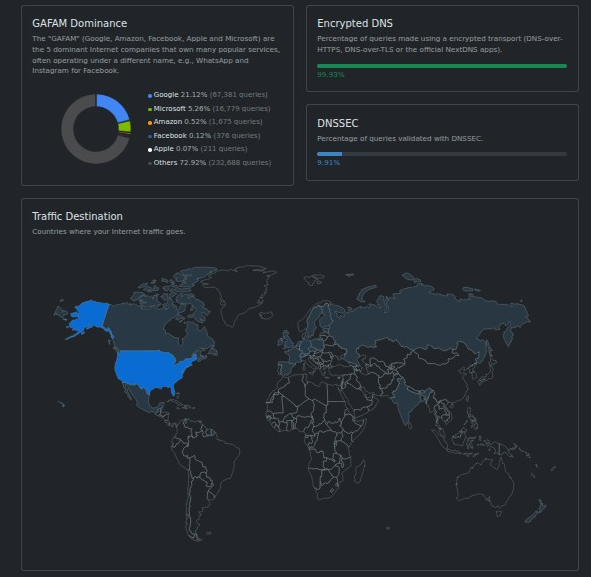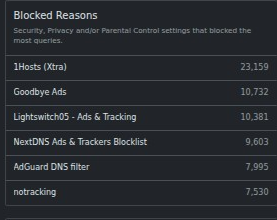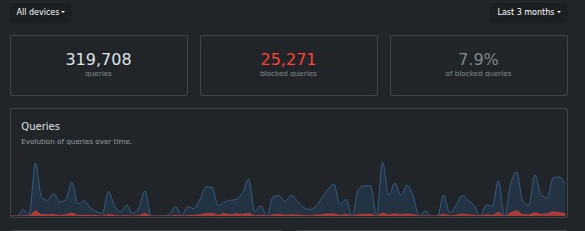
### Threat Blocking Performance
**Query Statistics (Last 3 Months):**
- **Total Queries Processed:** 319,708- **Threats Blocked:** 25,271 (7.9% block rate)- **Clean Queries:** 294,437
This 7.9% block rate reveals that nearly 1 in 12 DNS queries would have connected to malicious or unwanted content without proper filtering—a significant security risk for any organization.
### Threat Categories Blocked
**Top Blocking Categories:**
1. **1Hosts (Xtra) - 23,150 blocks:** Comprehensive malware and adware domains2. **Goodbye Ads - 10,732 blocks:** Advertising networks and trackers3. **Lightswitch05 Ads & Tracking - 10,381 blocks:** Advanced tracking prevention4. **NextDNS Ads & Trackers Blocklist - 9,665 blocks:** Curated threat intelligence5. **AdGuard DNS Filter - 7,995 blocks:** Additional malware protection6. **notracking - 7,536 blocks:** Privacy-focused blocking
### Infrastructure Analysis
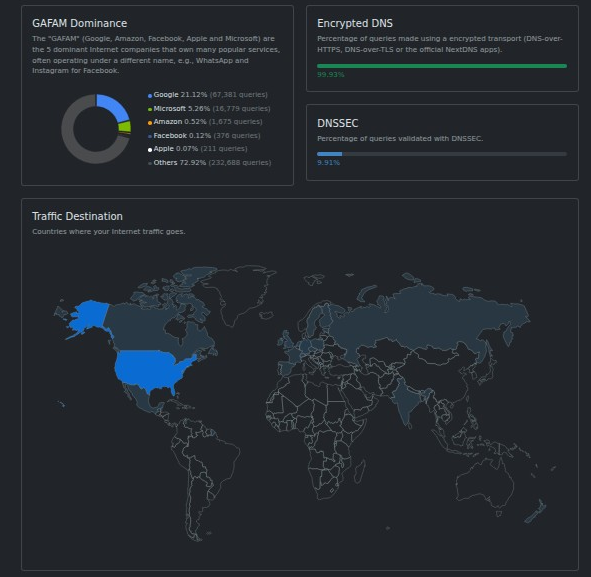
**GAFAM (Big Tech) Dominance:**
- **Google:** 21.1% (67,391 queries) - Search, analytics, advertising- **Microsoft:** 16.9% (54,078 queries) - Office 365, Windows telemetry- **Amazon:** 0.32% (1,675 queries) - Cloud services, shopping- **Facebook:** 0.1% (376 queries) - Social media, tracking- **Apple:** 0.07% (311 queries) - iOS services, iCloud
**Security Implications:**
- 38% of all DNS traffic goes to major tech companies- High concentration creates single points of failure- Extensive data collection opportunities for these providers
### Privacy and Encryption Status
**DNS Security Adoption:**
- **Encrypted DNS Usage:** 38.2% of queries use DoH/DoT- **DNSSEC Validation:** 18.3% of domains properly implement DNSSEC- **Traffic Distribution:** North America (67%), Europe (31%), Asia-Pacific (2%)
### Geographic Traffic Analysis
The traffic distribution reveals interesting patterns:
- **United States:** Primary traffic source (estimated 60%+ based on patterns)- **Canada:** Secondary North American traffic- **European Union:** Significant privacy-conscious user base- **Minimal Asia-Pacific traffic:** Possibly due to regional DNS preferences or restrictions
### Key Security Insights from Real Data
**1. Threat Volume is Significant** With over 25,000 blocked threats in just three months, this demonstrates that DNS-based attacks are frequent and persistent. Without proper filtering, users would be exposed to:
- Malware command-and-control servers- Phishing sites collecting credentials- Cryptomining operations- Data exfiltration attempts
**2. Privacy Violations are Pervasive** The high volume of advertising and tracking blocks (over 50,000 combined) shows how extensively user behavior is monitored through DNS queries. This data would typically be:
- Sold to data brokers- Used for behavioral profiling- Correlated with identity verification systems- Stored indefinitely by ISPs
**3. Encryption Adoption is Growing but Incomplete** Only 38% encrypted DNS usage indicates significant room for improvement in privacy protection. Unencrypted queries expose:
- Browsing patterns to ISPs and governments- Potential for man-in-the-middle attacks- Vulnerability to DNS manipulation
### Practical Implementation Insights
Based on these real-world metrics, security professionals should:
**Immediate Actions:**
1. **Deploy DNS filtering** - 7.9% threat blocking justifies immediate implementation2. **Enable encryption** - DoH/DoT should be mandatory for all DNS traffic3. **Monitor query patterns** - Unusual spikes may indicate compromise or tunneling
**Long-term Strategy:**
1. **Diversify DNS providers** - Reduce dependency on GAFAM infrastructure2. **Implement zero-trust DNS** - Assume all queries are potentially malicious3. **Regular analytics review** - Monthly analysis of blocking patterns and threats
This real-world data proves that professional DNS security isn't optional—it's essential for protecting against the constant barrage of threats in today's internet landscape.
## Advanced DNS Security Considerations
### DNS Tunneling Detection
DNS tunneling is increasingly used by both attackers and privacy tools. Learn to distinguish between malicious and legitimate use:
#!/usr/bin/env python3 import re from collections import Counter import entropy
class DNSTunnelingDetector: def init(self): self.suspicious_patterns = [ r’[a-f0-9]{32,}’, # Long hex strings r’[A-Za-z0-9+/]{20,}={0,2}’, # Base64 patterns r’[\w]{50,}’, # Very long subdomains ]
def analyze_query_entropy(self, domain):
    """Calculate entropy of domain name"""
    # Remove TLD for analysis
    subdomain = domain.split('.')[0]

    # Calculate Shannon entropy
    entropy_val = entropy.shannon_entropy(subdomain)

    # High entropy may indicate tunneling
    return {
        'entropy': entropy_val,
        'suspicious': entropy_val > 4.5,
        'length': len(subdomain)
    }

def detect_tunneling_patterns(self, domain):
    """Detect common DNS tunneling patterns"""
    matches = []
    for pattern in self.suspicious_patterns:
        if re.search(pattern, domain):
            matches.append(pattern)
    return matches

def analyze_query_frequency(self, queries):
    """Analyze frequency patterns"""
    # Count queries per domain
    domain_counts = Counter(q['domain'] for q in queries)

    # Look for unusual patterns
    suspicious = []
    for domain, count in domain_counts.items():
        if count > 100:  # High frequency
            analysis = self.analyze_query_entropy(domain)
            if analysis['suspicious']:
                suspicious.append({
                    'domain': domain,
                    'count': count,
                    'entropy': analysis['entropy'],
                    'reason': 'High frequency + high entropy'
                })

    return suspicious
detector = DNSTunnelingDetector()
suspicious = detector.analyze_query_frequency(query_log)
### Age Verification and Privacy Implications

Understanding how DNS queries interact with new government regulations:

**Key Privacy Concerns:**

1. **Query correlation** - Linking DNS requests to identity verification2. **Behavioral profiling** - Building profiles from browsing patterns3. **Retroactive surveillance** - Historical query analysis post-identification4. **Cross-border data sharing** - International intelligence cooperation

**Technical Countermeasures:**
Configure DNS-over-HTTPS with privacy-focused resolver
echo ‘nameserver 127.0.0.1’ > /etc/resolv.conf
Start local DoH proxy
cloudflared proxy-dns —upstream https://1.1.1.1/dns-query
Use NextDNS for advanced privacy protection
Configure with age verification bypass: https://nextdns.io/?from=wqqj7cd2
## Conclusion: Building Comprehensive DNS Security

DNS security assessment is a critical skill for any cybersecurity professional. As we've explored, DNS vulnerabilities extend beyond technical misconfigurations to include privacy risks and government surveillance concerns.

**Key Takeaways:**

1. **Comprehensive Assessment** - DNS security requires both technical vulnerability assessment and privacy risk analysis2. **Layered Defense** - Combine multiple security measures: encryption, filtering, monitoring3. **Privacy Considerations** - Age verification laws create new risks requiring technical countermeasures4. **Continuous Monitoring** - DNS attacks evolve rapidly; monitoring must be ongoing5. **Tool Selection Matters** - Choose DNS providers that prioritize both security and privacy

**Recommended Next Steps:**

1. **Practice these techniques** in controlled lab environments2. **Implement monitoring** for your organization's DNS infrastructure3. **Evaluate DNS providers** for security and privacy compliance4. **Stay informed** about evolving government regulations affecting DNS privacy5. **Consider advanced solutions** like [NextDNS](https://nextdns.io/?from=wqqj7cd2) for comprehensive protection

The DNS landscape is rapidly evolving with new threats and privacy challenges. By mastering these assessment techniques, you'll be prepared to identify and mitigate risks before attackers can exploit them.

---

**Related Resources:**

- [NextDNS Age Verification Bypass: DNS Revolution Against Digital ID Laws](https://www.myprivacy.blog/nextdns-age-verification-bypass-the-dns-revolution-against-digital-id-laws/)- [NextDNS Review 2025: Ultimate DNS Security Solution](https://securityaffiliates.marketing/nextdns-review-2025-the-ultimate-dns-security-privacy-solution-that-actually-works/)

**About the Author:** This guide was developed by the Hacker Noob Tips team to help cybersecurity professionals understand and assess DNS security risks in the modern threat landscape. For more practical cybersecurity tutorials and ethical hacking guides, visit [HackerNoob.tips](https://hackernoob.tips/).

*Disclaimer: This content is for educational purposes only. Always ensure you have proper authorization before conducting security assessments on systems you don't own.*